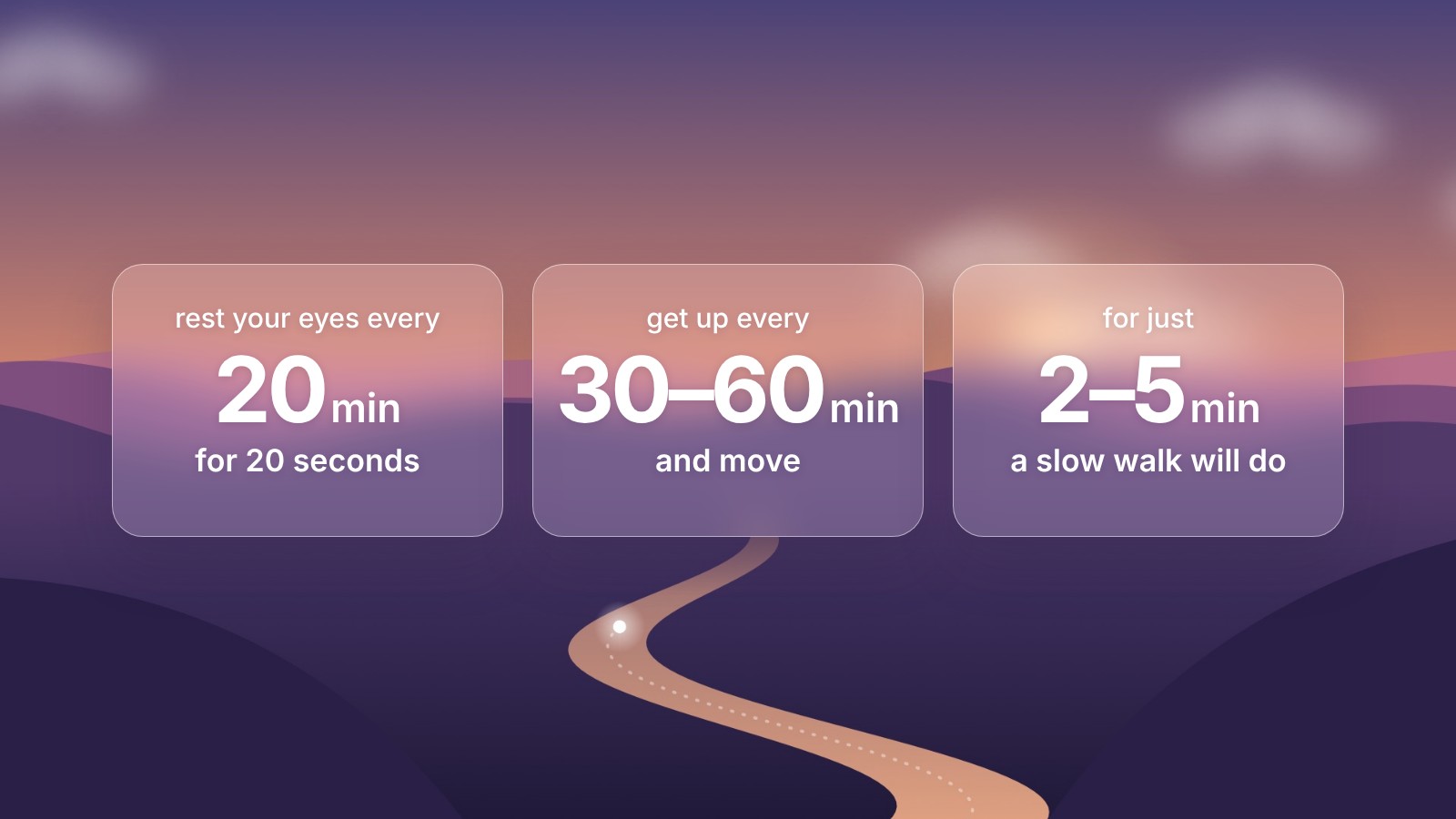
Ask how often you should take a break from the computer and you'll hear every 20 minutes, every hour, every 90 minutes. Hardly anyone says where their number comes from.
So we went and read the trials and systematic reviews on breaks from desk work. They don't give one number. They give different answers depending on whether you're asking about your body, your eyes or how tired you feel, and some of those answers are much better supported than others.
Your body: get up every 30 to 60 minutes
The research is clearest here. Several randomised trials have had people sit for a whole day in a lab, once without moving and once with short walking breaks, and compared what happened in their blood.
In a 2012 trial in Diabetes Care, Dunstan and colleagues had 19 overweight adults sit for 5 hours after a sugary drink. When they got up every 20 minutes for 2 minutes of walking, their blood sugar rose about a quarter less than when they sat straight through. Their insulin response was about a quarter lower too. Even an easy stroll did almost as much as a brisk walk.
In 2023, Duran and colleagues at Columbia University went further and tested different break schedules on the same 11 people over 8-hour days. They compared 1 or 5 minutes of walking, every 30 or every 60 minutes.
| Break schedule | Blood sugar | Blood pressure | Fatigue and mood |
|---|---|---|---|
| 5 minutes every 30 minutes | Spikes after large meals 58% lower | Lower | Better |
| 1 minute every 30 minutes | No clear change | Lower | Better |
| 5 minutes every 60 minutes | No clear change | Lower | Better |
| 1 minute every 60 minutes | No clear change | Lower | No clear change |
Every schedule brought blood pressure down by about 4 to 5 points. Blood sugar was harder to shift and only moved with the most frequent, longest breaks. People felt better with every schedule except a single minute an hour.
It seems to matter over years, not just days. In a study of almost 8,000 adults that we've written about before, people who sat in the longest unbroken stretches had about twice the risk of death of those who broke their sitting up most often. That held even after accounting for exercise.
The part people tend not to expect: a morning gym session doesn't cancel out a day of unbroken sitting. Getting up every half hour is best, every hour is still a lot better than nothing, and a slow walk to the kitchen counts.
Your eyes: look away every 20 minutes
The common advice here is the 20-20-20 rule: every 20 minutes, look at something 20 feet away for 20 seconds. It began as an optometrist's rule of thumb, and nobody tested it properly until a few years ago.
The results are mixed. In a 2023 trial, Talens-Estarelles and colleagues gave 29 computer users software that reminded them to follow the rule. After two weeks their eye strain and dry eye symptoms had eased, and a week after the reminders stopped, the symptoms came back. A lab study the same year by Johnson and Rosenfield found that scheduled 20-second breaks during a 40-minute reading task made no difference.
So the exact numbers aren't magic. Regular breaks from close focus probably help, and only while you keep taking them. At 20 seconds each, they're about the cheapest experiment you can run on yourself.
Your energy: short breaks fight fatigue
In 2022, Albulescu and colleagues pooled the results of 22 groups of people, 2,335 in total, in a meta-analysis of micro-breaks of 10 minutes or less. Breaks made people feel more energetic and less tired, a small but reliable effect.
Performance was a different story. Overall, breaks didn't make people measurably faster or more accurate. They helped on routine work like data entry, but not on demanding creative or analytical work. Longer breaks helped performance more than shorter ones, and the authors suggest that recovering from draining work may take more than 10 minutes.
An earlier office study points the same way. In a 2016 trial, office workers who walked for 5 minutes every hour felt more energetic and in a better mood by the end of the day than when they took one 30-minute walk in the morning.
In other words, short breaks keep you fresher, but they won't make you sharper at hard thinking. If you've been deep in something difficult for a couple of hours, a proper 15-minute break is the better bet.
Aches and pains: weak evidence
You might expect breaks to prevent sore necks, backs and wrists, and some studies suggest they do. In a 2001 trial by McLean and colleagues, computer workers who took micro-breaks had less discomfort in every body area measured, especially with breaks every 20 minutes. Their productivity didn't fall.
But the most careful summary of this research, a 2019 Cochrane review of 6 trials with 373 workers, found the evidence too weak to say much. It concluded that how often you take breaks "may have no effect" on pain, discomfort and fatigue, with low certainty, and called for larger trials.
Breaks might help with discomfort, but we wouldn't count on them. If something hurts, look at your chair, screen height and keyboard first, and see a professional if it doesn't go away.
A rhythm you can follow
If you want one routine that fits all of the above, this is the one we'd suggest:
- Every 20 minutes, look out of a window or across the room for 20 seconds, and blink a few times.
- Every 30 to 60 minutes, stand up and move for 2 to 5 minutes. Get some water, take the stairs, stretch.
- After 90 minutes to 2 hours of hard focus, take a real break of 15 minutes or more.
- Keep going. In nearly every study, the benefits faded once people stopped.
The last step is the hard one. Nobody remembers to look up every 20 minutes when they're busy, which is the problem Meander is for. It's a free break reminder for Mac that can follow either rhythm, and it waits until you're off a call or done with a video before it asks.
How good is this evidence?
Now the caveats. Most of these trials are small, with 11 to 29 people, and many ran for a single day in a lab rather than months at a real job. Several looked at middle-aged or overweight adults, so the results may differ for younger people. The longer-term studies show links, not proof of cause and effect.
What gives us some confidence is that very different kinds of study keep landing in the same place. Getting up regularly is good for your body, short breaks help your eyes and your energy, and none of these studies found that breaks cost people any work.
This article is general information, not medical advice. If you have pain, eye trouble or a health condition, talk to a professional.
Sources
- Dunstan and others, Breaking up prolonged sitting reduces postprandial glucose and insulin responses, Diabetes Care, 2012
- Duran and others, Breaking up prolonged sitting to improve cardiometabolic risk: dose-response analysis of a randomized crossover trial, Medicine and Science in Sports and Exercise, 2023, and Columbia University's summary
- Talens-Estarelles and others, The effects of breaks on digital eye strain, dry eye and binocular vision: Testing the 20-20-20 rule, Contact Lens and Anterior Eye, 2023
- Johnson and Rosenfield, 20-20-20 rule: are these numbers justified?, Optometry and Vision Science, 2023
- Albulescu and others, "Give me a break!" A systematic review and meta-analysis on the efficacy of micro-breaks for increasing well-being and performance, PLOS ONE, 2022
- McLean and others, Computer terminal work and the benefit of microbreaks, Applied Ergonomics, 2001
- Luger and others, Work-break schedules for preventing musculoskeletal symptoms and disorders in healthy workers, Cochrane Database of Systematic Reviews, 2019
- Diaz and others, Patterns of sedentary behavior and mortality in U.S. middle-aged and older adults, Annals of Internal Medicine, 2017, covered in our guide to sitting and a longer life
- Bergouignan and others, Effect of frequent interruptions of prolonged sitting on self-perceived levels of energy, mood, food cravings and cognitive function, International Journal of Behavioral Nutrition and Physical Activity, 2016